
Kids Straw Cup vs Water Bottle: A Retail Buying Guide
Compare a kids straw cup vs water bottle by grip, closure and intended use, not the product name. Either format can use a straw. For retail buyers, the model’s handling, transport and care instructions determine its role; small capacity alone does not establish an approved age.
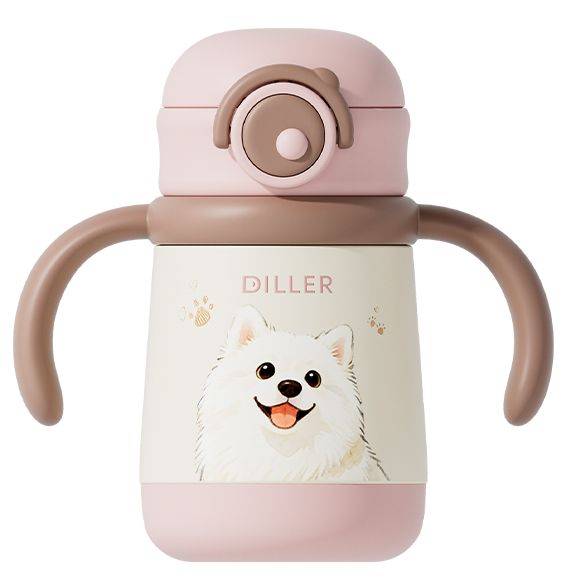
D9617: a 300 ml dual-handle straw cup. Cup format and small capacity do not by themselves establish an approved age.
Start with the format, not the word cup
The naming problem begins when buyers compare catalogue titles instead of complete products. A handled straw cup, a bottle with a lid that doubles as a cup, and a closed bottle with a straw can all include the word cup somewhere in their description. They still create different handling and transport expectations.
Look at the vessel, the grip arrangement, the drinking opening and what happens when the product is closed. Ask which parts are used during drinking and which are used during carrying. This separates the question in this guide from straw versus direct-drink lid selection, which compares drinking modes rather than the whole format.
| Comparison | Straw-cup proposition | Water-bottle proposition | Buyer check |
|---|---|---|---|
| Grip arrangement | May emphasise side handles and drinking grip | May use a loop, handle, strap or body grip | Review the intended hand positions |
| Drinking system | Straw, valve and lid must be reviewed together | May use straw, direct-drink or interchangeable lids | Confirm the exact supplied configuration |
| Closure and transport | The word cup does not establish bag suitability | The word bottle does not prove leak resistance | Check closure instructions and performance evidence |
| Care | Handle attachment and straw access matter | Lid, seals, carry parts and body access matter | Use finished-product instructions, not assumptions |
Two handles make D9617 visually different, not universally suitable
The current Diller Kids D9617 record describes a 300 ml straw cup with two side handles, a soft silicone straw and a locking push-button lid. Its listed materials are 316 stainless steel, PP and silicone. The paired handles provide an obvious comparison point against a loop or strap bottle.
Those details support a form-factor discussion. They do not prove that the model is suitable from birth, that it meets a particular country’s toddler-product requirements, or that every user can operate the button. Confirm the intended use, approved age positioning, component security and supplied instructions before creating a baby-store listing.
For a sample review, examine hand clearance around both handles, access to the opening control and the drinking angle. Record how the vessel is placed down and how its components are removed and reassembled for cleaning. Use those observations to define the retail role; do not turn a small capacity into a blanket age claim.
A bottle with a cup lid is not a dual-handle straw cup
D9556 is listed as a compact 280 ml insulated bottle with two drinking modes, a portable strap and a lid that doubles as a cup. That cup is part of a bottle configuration. It should not be presented as equivalent to the two-handled D9617 simply because their capacities are close.
Ask what the standard lid set includes and show each configuration clearly. A product sheet should identify the bottle capacity, the lid function and the supplied accessories without implying that every component can be used with every temperature or user group. The care and use instructions remain specific to the assembled product.
MLH9091 adds a separate 350 ml insulated reference with interchangeable straw and direct-drink lids. Use these examples to explain the customer’s choice in a few clear comparisons. Do not make the buyer discover the difference by reading a long list of interchangeable catalogue names.
A closed carry bottle serves another assortment role
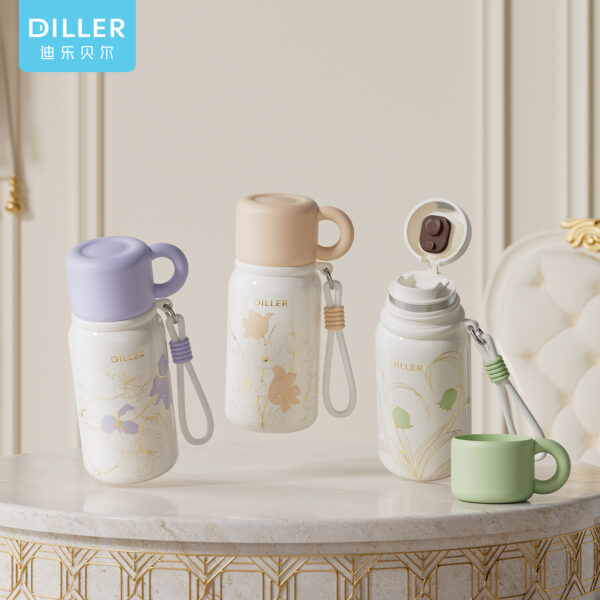
D2624 is a 380 ml Tritan bottle with an integrated loop and two drinking modes. D2607 is a larger 810 ml PPSU model with a carry strap and straw/direct-drink functions. Their descriptions centre on bottle configurations and carrying arrangements rather than two side handles.
A retailer may need a compact cup and a larger bottle in the same branded range, but the larger bottle is not automatically the next age stage for the cup. Capacity, empty and filled weight, body diameter, closure operation and cleaning should all be considered. Review the age-based selection guide before assigning age wording.
Similarly, a cup is not automatically only a home product and a bottle is not automatically suitable for a school bag. Those are positioning hypotheses to examine against the actual product. Verify closure and intended-use instructions before describing where it can be carried.
Five model references for a cup-and-bottle range
These current catalogue references were checked on 14 October 2026. They illustrate form-factor and capacity differences. They do not certify age suitability, temperature use, cleaning methods or current stock.
| Model | Capacity | Listed materials | Comparison role |
|---|---|---|---|
| D9617 | 300 ml | 316 Stainless Steel / PP / Silicone | Dual-handle straw-cup reference |
| D9556 | 280 ml | 316 Stainless Steel / PP / Silicone | Compact bottle with cup-lid feature and strap |
| MLH9091 | 350 ml | 316 Stainless Steel / PP / Silicone | Compact insulated bottle with two lid configurations |
| D2624 | 380 ml | Tritan / PP / Silicone | Compact transparent bottle with integrated loop |
| D2607 | 810 ml | PPSU / PP / Silicone | Larger PPSU carry-bottle reference |
Care instructions can change the retail decision
Ask for finished-product instructions covering the body, lid, straw, seals, handles and removable accessories. Confirm how parts are detached, cleaned, dried and fitted again. A metal body does not establish dishwasher suitability, and a plastic material name does not automatically permit sterilisation or hot drinks.
Do not transfer a weighted-straw claim, cleaning temperature or age recommendation from another brand’s cup to a Diller Kids model. The D9617 record identifies a soft straw, not a verified weighted-straw system. If the buyer requires a particular flow mechanism, request evidence for that exact configuration.
The European Commission food-contact overview covers materials and articles placed on the EU market. It illustrates why evidence should address the finished article and its components. For Southeast Asia or Middle East distribution, agree the documentation required for the actual destination rather than treating an EU reference as universal approval.
CPSC guidance provides a separate US example: intended use, manufacturer statements and product presentation matter when classifying children’s products. Its children’s-product guidance does not approve an individual Diller model or replace a local age and compliance review.
Build a range brief with separate jobs for each model
An illustrative family-retail shortlist could include one paired-handle cup, one compact carry bottle and one larger format only if the channel needs it. Avoid offering several nearly identical products just to fill an age ladder. This is a planning suggestion, not a prescribed order mix or a tested consumer preference.
For each model, write one sentence explaining its role, then list the supporting capacity, material and handling evidence. Add the approved care wording, accessory configuration and open questions. This is more useful to a retail team than calling every item a perfect bottle for all children.
Download the cup-and-bottle range review worksheet (CSV). It leaves age evidence, sample observations and the purchasing decision blank so the team can record genuine findings.
Selected confirmed stock may start from 50 pieces, but model availability and any mixed-colour or mixed-model arrangement must be confirmed. Review the Diller Kids branded distribution programme, then share your country, channels, preferred models and quantities in the inquiry. OEM/ODM remains a separate route when a custom configuration is actually required.
For a kids straw cup vs water bottle decision, the useful answer is not that one format is always better. Give each shortlisted product a distinct handling and retail job, supported by the exact configuration, sample review and destination requirements.
Frequently asked questions
What is the difference between a kids straw cup and a straw bottle?
A straw describes the drinking system, not the whole vessel. A cup may use two side handles, while a bottle may use a loop or strap and a different closure. Compare the complete design and intended use rather than assuming the names establish age or transport suitability.
Is a cup-lid bottle the same as a toddler straw cup?
No. D9556 is listed as a bottle with a lid that doubles as a cup; D9617 uses two side handles and a straw. These are different configurations. Neither description alone approves a product for a particular age or care method.
Does D9617 use a weighted straw?
The current Diller Kids record describes a soft silicone straw. A weighted-straw mechanism is not verified in that record. Buyers needing a particular mechanism should request the exact configuration and supporting evidence.
Can a retailer launch both formats in one branded range?
Yes, if they serve different jobs and each product has suitable evidence and instructions. A compact cup and a carry bottle can be compared as an opening shortlist, but age claims, availability, colour mix and order quantities must be confirmed model by model.
Built on 16 years of drinkware experience.
Our buyer guides combine product development, material, quality-control and international market experience. Confirm final specifications and destination requirements for each selected SKU.
Prepare a focused Diller Kids shortlist.
Share your country, sales channel, selected models and quantities. We will confirm the configuration, stock conditions, packing and partner quotation.